--- title: "How Do You Paint a War?" subtitle: "Picasso’s Guernica and the artistic choices that transformed violence into an enduring image of anti-war resistance" category: "Art History" ---
From Historical Event to Artistic Testimony
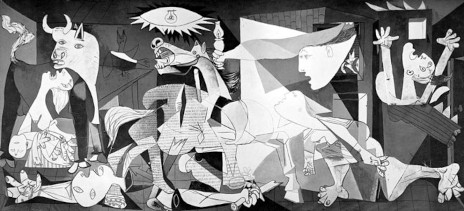
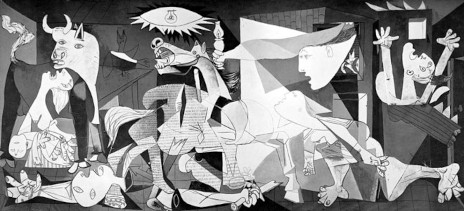
Guernica, an anti-war response to the Nazi bombing of a Basque town during the Spanish Civil War by Pablo Picasso, is one of the most important artworks in the century, also the symbolization of anti-war art. Through a monochrome palette, multi-centered compostition, and distorted figuration of people and objects, Guernica shattered all the beautiful things we believe in a world, moving millions of people across the world. Guernica was not an abstract statement against wars, instead, it is a direct answer to the most recent news then, the bombing of the Basque town of Guernica by German and Italian military forces specifically warplanes on April 26, 1937. The attack killed hundreds of civilians and basically marked one of the first aerial bombings of a civilian population in modern history. Therefore, as the painting was neither created as a painter’s abstract manifesto or as a commision, it was expected to be a specific, documented demonstration of absolute atrocity in front of an international-scale of audience. This sets, that the painting was created as every artistic choice of Picasso carries the weight of expected testimony. Consequently, the historical reality of Guernica transformed the painting from a work of art to an evidence in an expressive form. The choice of Picasso - that he chose to paint specifically respond to one incident - predicts the scale of its impact and the resonance (of empathy and fear) among the public.
A World Stripped of Color
The most noticible choice of the painting is that it was painted entirely in black, white, and grey. The most obvious interpretation is that brutal acts like bombing took colors away from the world. Apart from this, Picasso, by stripping away hue, eliminated any form of intentional beauty of visual comfort, there are no colors to soften the scene, it was demonstrated the most authentically - dark, brutal, and sharp. The overall choice of color tone provided the audience an atmosphere of the war. Also, the people in the painting are depicted to be white (or left blank), while the background was pure darkness. It feels like as if the pale bodies are unhidable in a situation like that, giving the audience great sense of fear and desperation. Also, the whiteness of livings and darkness of ashes contrasted life and death through the white and black. The visually unsettling comparison of color evoked the deeper meaning of the painting, having the audience to reflect how life and death are in extreme situations like the war.
A Composition Without a Center
Picasso also deliberately designed the composition - there exist none center. Unlike traditional artistic choices in which perspectives or lighting guide viewer toward a focal point, typically where the major event is happening, Guernica has not single focal point, instead it has multiple happenings going on: A griefing mother holding a child, a horse screaming with fear, a women leaning in, a falling figure, a women trapped in fire. This multi-centered design forced viewers to rapidly switch from one to another, intensifying the chaos by never finding a place to rest. This creates an unsettling effect for the viewers, as they are trapped in chaos, disorientation, and inablility to escape. Picasso wanted to indicate that nothing is stable nor centered, the composition created a tumult resulted from violence.
The Distortion of the Human Body
Perhaps the most unsettling part of the whole painting is the fuguration of details, and of humans. He did not created sense of fear in people through visualizing wounds or blood, instead, he used cubism to fragment and distort the figures through transforming their bodies into geometric planes: the grieving mother tilted at an impossible angle, her tongue sharp as a sword, the body of the horse is split, a man lying down with head thrown back. People feels the unsettling just by watching the distorted figures. The choice of deformation and contortion through cubism created sense of agony, suffering, anguish, and despair in the audience. This suffering amplifies at the cracks on creatures, as they (the audience) see the humanity falling apart.
From Guernica to a Universal Anti-War Symbol
Until now, figures in the Guernica are still the spiritual symbols of anti-war movements, as their images frequently appear on the boards of the parades, of people in agony defying wars. This unprecedented effect was created through Picasso’s deliberate choice of responding to specific incident, monochrome color, multi-centered composition, geometrisation and distortion of figures. Guernica makes us the witnesses, not to this single historical event, but more to a collapse of order and humanity. This made Guernica valuable even until decades later, because it speaks where words fail.