
--- title: "The Language of Domesticity" subtitle: "From Mary Cassatt’s The Tea to Martha Rosler’s Semiotics of the Kitchen, how visual signs construct—and challenge—the roles assigned to women." category: "Art History" ---
The Language of Domesticity
From Mary Cassatt’s The Tea to Martha Rosler’s Semiotics of the Kitchen, how visual signs construct—and challenge—the roles assigned to women.
Martha Rosler’s video Semiotics of the Kitchen captures her performance on the politics and symbolism of domestic labor. In the video, Rosler moves through the alphabet using kitchen utensils in a kitchen surrounded by a refrigerator, table, and stove. She repeatedly stabs a fork forward, mimics the act of scooping soup, swings utensils with exaggerated movements, and lifts an empty spoon from a coffee cup before letting her hand drop.
At first, these scenes appear absurd and almost meaningless. Rosler provides little conventional explanation throughout the performance, while her expression embodies anger, irritation, and firmness. Created in 1975, the work emerged in the context of postwar American media culture, when television cooking programs and images of domestic femininity had become deeply embedded in popular culture. Rosler transforms the familiar language of the cooking demonstration into a critique of the ways women were repeatedly represented through domestic labor.
She speaks, with rage and frustration, against restrictive expectations placed upon women through a language of signs.
From Rosler to Cassatt
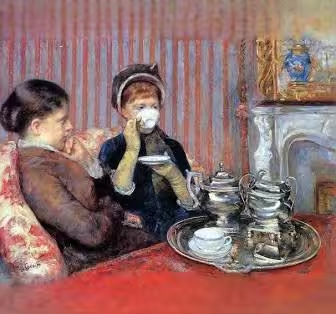
Rosler’s expression and the essence of her performative behavior can be compared with Mary Cassatt’s oil painting The Tea. As one of the most prominent female artists associated with Impressionism in nineteenth-century Paris, Cassatt frequently depicted women within the social and domestic spaces available to them.
In The Tea, two women are situated in an elegant interior surrounded by silver tea service and decorative furnishings. Everything initially appears pleasant and comfortable: one woman raises a cup while the two seem to occupy the familiar ritual of a social visit.
Yet the setting can also be read differently. Contrasting stripes form the background wallpaper, while dark red elements project toward the viewer, creating a compressed and enclosed space. The women appear surrounded by the visual codes of refinement, domesticity, and upper-class femininity.
This resembles, although in a very different historical context, the setting of Semiotics of the Kitchen, where Rosler appears surrounded by an almost overwhelming vocabulary of kitchen utensils and domestic signs. Apart from the setting, the figures in both works can be read as expressing a certain aversion or distance from the situations they inhabit—one nuanced and ambiguous, the other direct and confrontational.
Two Languages of Resistance
In Cassatt’s work, the women exist within conventions of the salon, aristocracy, elegance, and femininity. Their expressions can be interpreted as distracted or detached from the social ritual taking place around them. Cassatt does not give us the explosive resistance that appears in Rosler. Instead, the tension exists quietly within posture, expression, and space.
Rosler’s performance, by contrast, is inundated with anger and aversion. Through exaggerated actions and an unwavering expression, she transforms ordinary kitchen utensils into instruments of confrontation.
Rosler’s work strongly criticizes the cultural tendency to associate women with kitchens, food preparation, and domestic labor. Such associations did not suddenly appear in the 1960s; women had been connected to domestic labor for centuries. However, twentieth-century advertising, television, consumer culture, and postwar ideals of domestic femininity helped reproduce and popularize particular images of the woman as homemaker.
What interests me is how conventions like these become so familiar that they begin to appear natural.
Path Dependency and the Making of a Stereotype
This recalls a topic I previously researched: path dependency.
Path dependency describes how decisions, conventions, or circumstances established in the past can continue to influence the present, even when their original conditions have changed. Systems can become difficult to replace simply because society has already organized itself around them.
The QWERTY keyboard is frequently discussed in debates surrounding path dependency: regardless of arguments over why its particular arrangement survived, its continued dominance demonstrates how an established system can become extraordinarily difficult to replace once infrastructure, habits, and expectations develop around it.
Social conventions can operate in similarly persistent ways.
From this perspective, Rosler’s work becomes especially interesting. She identifies a cultural system that might otherwise appear ordinary—the association between women, kitchens, and domestic labor—and makes its constructed nature visible. Through exaggeration, repetition, and absurdity, she turns something familiar into something strange enough to question.
When Language Carries Ideology
Rosler’s work also reflects another idea: stereotype, prejudice, and inequality can become embedded in systems of language and representation.
How can something as fixed and seemingly neutral as an alphabet become susceptible to ideology?
In Semiotics of the Kitchen, the alphabet becomes a structure through which domestic objects acquire meaning. The performance resembles the language of education: an object is named, demonstrated, and assigned to a letter. Yet Rosler disrupts that familiar structure through violent and exaggerated gestures.
The seeming imitation of educational language reveals how systems of naming and representation can symbolically bind women’s bodies to domestic labor.
Language does not merely describe the world around us. It can also preserve categories through which we have learned to understand that world.
Making the Familiar Strange
Ultimately, Semiotics of the Kitchen succeeds because Rosler takes an ordinary environment and makes it impossible to view neutrally.
Her performance demonstrates how conventions can become embedded so deeply within everyday life that we may stop recognizing them as conventions at all. By disrupting familiar signs—the alphabet, the kitchen utensil, the cooking demonstration—Rosler forces the viewer to reconsider the meanings attached to them.
Placed beside Cassatt’s The Tea, the contrast becomes particularly striking. Cassatt presents the domestic and social world through quiet tension; nearly a century later, Rosler turns that tension into confrontation.
Both works invite us to look again at spaces and behaviors that might otherwise seem ordinary.
Perhaps that is what makes their comparison compelling: the kitchen, the tea table, the alphabet, and the objects surrounding us are never entirely neutral. They carry histories—and sometimes, expectations we have inherited without realizing it.