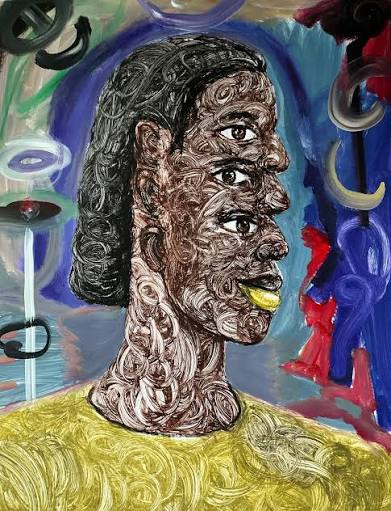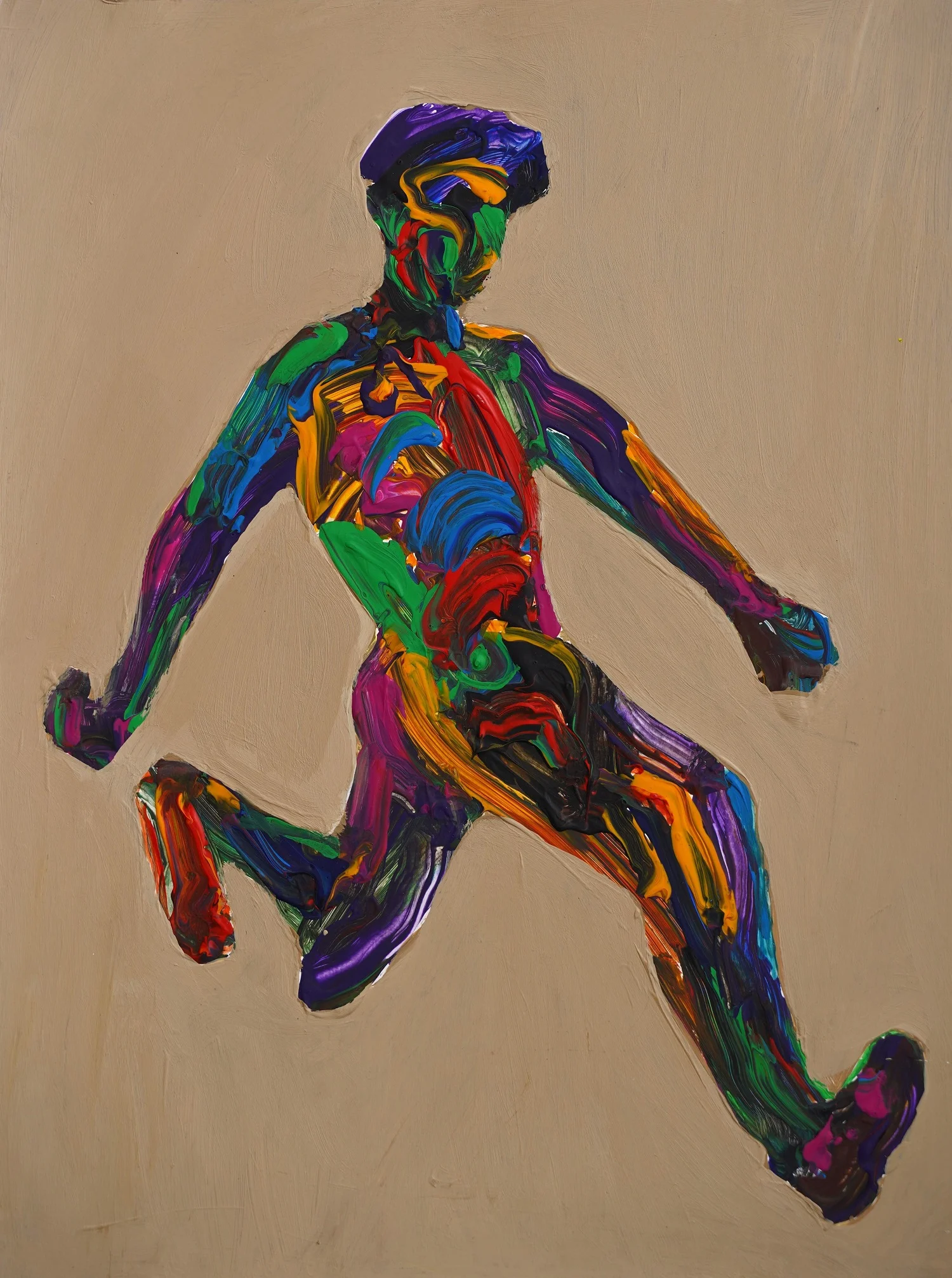
“I didn’t get anybody to like it or be interested. I didn’t think about it. It just comes when I feel I have to. It is free of thought or anything. I just do it.”
Edward Ofusu is an artist based in Accra, Ghana. Deeply influenced by his roots in African Art and education in England, his work demonstrates strong visual impact as well as personal meaning. In this conversation, his words spans from his personal experience, understanding of contemporary art, and his future goals.
To begin, could you introduce yourself and tell us a little about your artistic practice today?
Edward: My name is Edward Ofusu, and I am based in Accra, Ghana. I have started professionally painting since 2012, where I had the confirmation within myself that: “This is what I want to do, and I am not gonna look back”. And since then I started painting (landscape, portraiture) and tapestry, where I started to sew my works together inspired by my mom’s sewing since I was a little boy. I also do sculptures and digital art. I just like to play around.
Specifically, how did you first come to art, and how has your practice evolved since then?
Edward: As a little boy, there has always been this voice inside telling me I am going to be an artist. In Ghana, art is always in the background. I remember when I was in school, there was a point where you had to choose the subject you are going to study. I ended up studying science subjects like chemistry, biology, physics… And the only subject I enjoyed was biology because there you can draw… Some of my friends who are artists were in art class, and I realized “Art, I can do art”. So I always had it inside of me.
It was later that I traveled to London, I visited the gala and museums. And then I started to pick up the brush again. And then from then I will practice and practice. Sometimes I will be in the museum for 7 hours just standing and drawing, and sometimes the security will come and ask me to take a chair, and I will be “No, because the height will be wrong. ”
2012 I had one of my paintings in exhibition, a painting of the queen of England I believe. The woman who was in charge of the exhibition gave me the first prize, because I think she believed the painting was from the national gallery. So she asked who this is. She asked me where I go to school and I said I have not been to art school, and then she said she's the principal of an art school and she invited me into the art school. So that was the first time I had a connection with an art school. When I went to her office, she gave me the opportunity of a year of free art sessions. I got to join whatever class I like. So I was at school for one year just learning portraiture.
And then I started teaching at the school as well. So then I started to be part of the teaching, and that is how I started to paint more and become more into it. Then I started getting a few mentions with my work and publicity, and I was runner-up Artist of the Year [unclear]. I also started to teach iPad art in the Apple Store and places.
I knew that this is what I wanted, that this is what I was going to be. And then in 2018, I was deported [possibly: relocated/moved] from London to Ghana, and now I am here as a full-time artist, enjoying the journey.
Speaking of digital art, what do you think of iPad Art?
Edward: Yes, I mean, when I started, you know, I didn’t use the Apple Pencil. I would use my finger. That was before the Apple Pencil came out. I just used my fingers to draw on the screen.
How did you develop your own artistic style and move away from traditional education?
Interviewer: So another next question that I have, like, I’m just curious - with every artist, you develop a style. You can obviously see that you have a certain pattern of style. How do you move away from traditional education of art? How do you develop your own style?
Edward: Okay, so one of the things that, while I was in London, one of the things we did was [unclear] painting. We had to paint [unclear] to show it in a different tone.
There was a traditional broom. We have this use to paint. I had to paint paintings. I discovered another point—something people used to do—but that became my new style that I’m doing.
So I think it is more experimenting, trying different things. And then you can bring different things together into one. You know, in your mind, anything can be done.
I’m more free, is what I mean. And when I look back, I see that if I stopped when people said, “Your portrait is more real,” if I stopped, I wouldn’t have discovered where I am now.
So you have to keep going and keep playing, and now something comes out.
it’s just fun to discover the style.
Why do you make so many portraits?
Interviewer: And I actually scrolled through your social media account, and I’ve seen that you make a lot of portraits - for example, like in your background there are portraits. Why do you like portraits that much? What do you think a portrait represents personally for you?
Edward: Why I like portraits is because it is instant. It’s easy. It’s a form to capture life. For instance, around the time I was in London, and then also, I have done more than twenty portraits.
Bold colors, geometry, fragmented shapes, and abstraction
Interviewer: Another feature about your art - you have very bold colors, and I see geometry and also fragmented shapes and forms within your work. How do you think that allows you to express something more than something realistic? Especially the geometric structures and abstract forms in paintings?
Edward: Yes. So the abstract paintings have always been part of the journey. But I almost stopped because somebody said, “Nobody will understand.”
So then I had separate paths. I didn’t get anybody to like it or be interested. I didn’t think about it. It just comes when I feel I have to. It is free of thought or anything. I just do it.
Do you think context is required to understand abstract art?
Interviewer: Do you think people need to understand the nature of abstract art to appreciate one, in a world where people are instinctively more accustomed to form with narrativity and form?
Edward: Yeah, I think the history, the education, is important. But also it’s human nature to be scared of the unknown. For instance, if I come to China I will be surprised by all the robots!
What do you want audiences to take away from your art?
Interviewer: For example, like, your work is in an exhibition and then it is an abstract form of art. And then someone, like, they don’t really know about abstract art or they can’t really understand the abstract form. What do you want them to take away, in terms of thought or understanding? What do you want them to take away from your art?
Edward: I think the sense of wonder. The sense of wonder. I want you to be surprised and shocked.
What do you want to explore next?
Interviewer: Looking forward, are there any ideas or themes or subjects or forms that you want to explore, like, next, within the next year or next five years?
Edward: I think about my work—I don’t give a kind of planning. I had a lot of time to do art. But, like, I’ve just done a series of 101 African leaders, which took three or four years to finish. I just finished this last month.
So I’m thinking, “What is the next journey?”
I just had a thought about this: “I am.”
That is what I want to play with. I want to play with “I am.”
You know, “I am” can become anything. Every form is something. Everybody uses “I am.” If you’re from India, “I am...” The word “I am. Everybody introduces themselves by saying: “I am... I am...” It can become so many things.
“I am” is the foundation of yourself.
Interviewer: Identity?
Edward: Identity, exactly.
I’m telling the African storing and I am exploring.
So in the future, like, the next year, it will just be where the thing will take me, not what I want it to be, or where it’s gonna take—
Is there an artist whose work changed the way you understand art?
Interviewer: And this is, like, a very personal question: is there an artist or work that inspired you and changed how you think, how you understand art, like, as an artist?
Edward: I just—I think this one. I was blown away. His name is Alex Grey, an American artist. So when I saw his work, I said, “Oh wow, you got me.” So I quickly went online and bought his art book, and was looking through his stuff.
What advice would you give to young artists trying to discover their own style?
Interviewer: Because we do have, like, a lot of young artists as the audience of this, so what would you say to any young artist who’s just, like, starting his or her career, trying to discover their own style?
Edward: I would say that sometimes, in some of my art classes, there are some students—I tell them, “Your best work is going to come after you’ve done hundreds.” So just keep, keep, keep on doing.