ARTIST VOICES · Edited Q&A
Artist: Xiangyun Lotus Liu | Interview & Editing: Admin | 2026
Working across new media, installation, interaction, performance, and fashion, Xiangyun Lotus Liu’s practice moves between different forms rather than settling into a single medium. Her work often returns to questions of observation, identity, time, participation, and the relationship between people in increasingly mediated environments.
Originally trained in experimental and intermedia art, Liu has also worked as a model and curator. These parallel experiences have shaped the way she thinks about both viewing and being viewed, as well as the role of the audience within an artwork.
In this conversation, she reflects on how she entered new media art, how modeling changed her understanding of performance, why interaction matters, and what it means to remain human as AI becomes increasingly embedded in creative practice.
Q. You studied experimental and intermedia art at a time when those fields were still relatively unfamiliar in China. What first drew you toward this kind of practice?
A. When I entered the Intermedia Art program in university, it was not a direction that people necessarily thought highly of. At the time, more traditional disciplines such as Chinese painting, oil painting, printmaking, and sculpture were still seen as the more established paths.
Around 2013, I saw Marina Abramović’s The Artist Is Present. That work had a strong impact on me. I suddenly felt that this kind of artistic expression could reach me more directly and give me another way of understanding art.
It was not only about that particular work. I also became interested in the different ways artworks could be presented in museums. When the way a work is shown changes, the way you encounter it changes too. That difference from traditional easel-based art made me realize there were many other possibilities for what art could be.
That was what led me toward new media and experimental practice.
Q. Before becoming an artist, you were actually very interested in mathematics. Do you still see that way of thinking in your work today?
A. Yes. I used to be very interested in mathematics and once imagined studying pure or applied mathematics.
Looking back, I think that way of thinking still affects me. New media, installation, and technology-based work often require logical and spatial thinking. My sense of space has always been quite strong, so when I began working with 3D software, I was able to understand it relatively quickly even though I did not come from a sculpture background.
There is something about imagining forms in space that feels similar to mathematical thinking.
For me, this is also why art does not have to be divided too strictly into categories. Whether I am using digital tools, physical materials, performance, or something else, I am still trying to solve a problem through form.
Q. You have worked as an artist, model, and curator. How has modeling, in particular, influenced the way you think about art?
A. Modeling influenced me a lot, especially in terms of the relationship between watching and being watched.
One of the things that attracted me to The Artist Is Present was exactly this relationship. Modeling is very similar in that sense. A model is constantly being watched, observed, and asked to perform something.
Even though the purpose may simply be to present clothing or communicate a designer’s concept, your body is still placed inside a system of viewing.
When I was modeling, I was also taking photographs of other people. So I was moving between being the person who looks and the person who is looked at.
Because I was not trained in a very conventional way as a model, my runway movement sometimes looked closer to performance art. Interestingly, some designers with stronger contemporary art backgrounds actually responded to that.
Those experiences made me much more conscious of how identity can shift depending on who is watching, who is performing, and who controls the situation.
Q. Your work moves between many different media. When you begin a project, how do you decide which medium is right for an idea?
A. It can happen in different ways.
For a commercial project, the medium may be shaped by very practical things: the client, the budget, the space, the available materials, and what can actually be produced.
Open calls can work in a similar way because the format may already be partly defined.
But in my own practice, I also have subjects that I continue returning to. In that case, the question becomes how to find the most appropriate form for the idea.
Compared with when I first started making art, I think I have more methodology now. In the beginning, I might have felt that once I found the right method, I could simply express the idea.
Now I think much more about how something will be realized: how long it will take, how it will exist in a space, how people will encounter it, and whether the form really supports the concept.
Q. Interaction appears frequently in your projects. What does audience participation add to a work for you?
A. I am interested in interaction because I do not always want the audience to simply stand in front of a work and watch something happen.
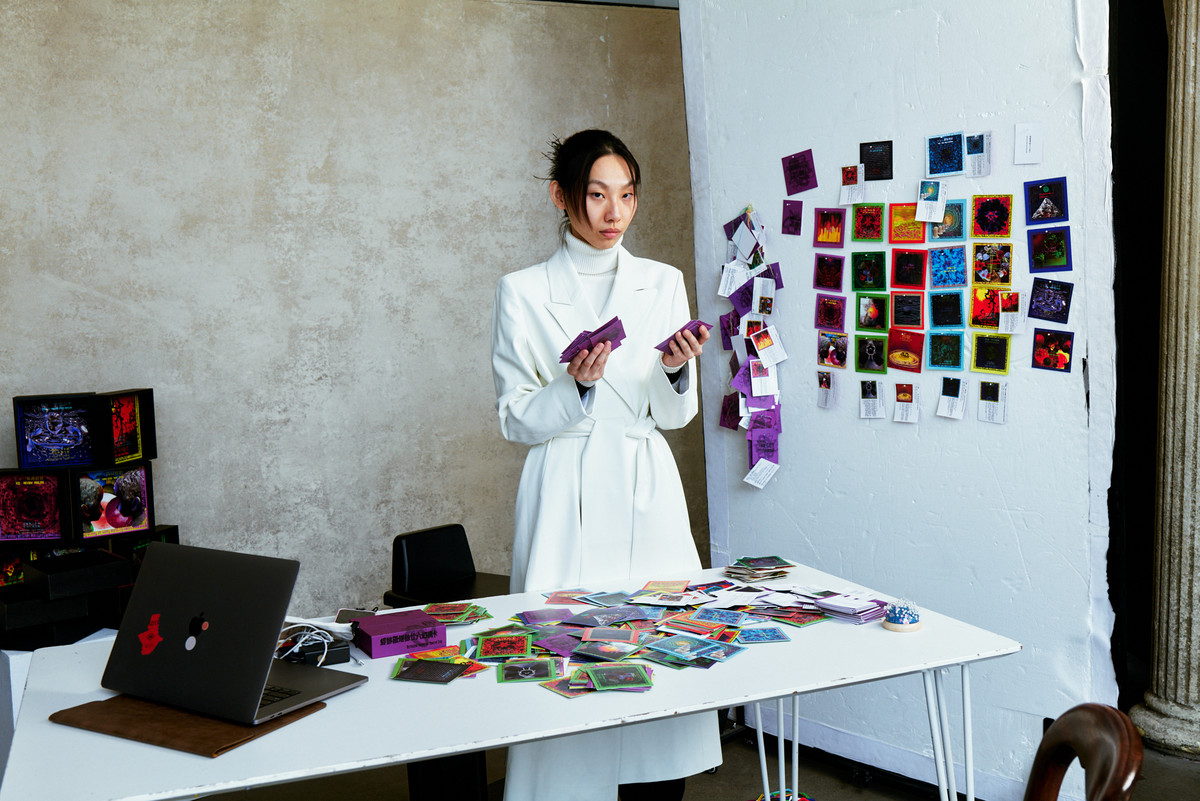
For one project, I created a system in which visitors could write their thoughts anonymously on transparent cards and place them within the exhibition space. I also played a recorded speech through a small speaker in the background.
I knew that people would already be gathered together at the opening, so instead of turning the situation into a performance where I acted and everyone watched, I wanted them to become part of the work.
For me, participation changes the relationship between the artwork and the viewer.
The viewer is no longer only interpreting something that has already been completed. Their presence begins to affect what the work becomes.
That is one of the reasons I remain interested in interaction: the human being is still there.
Q. Time, cycles, death, and rebirth also appear repeatedly in your work. Where did that interest come from?
A. I think my interest in time and cycles became much stronger after I temporarily stopped making art.
When I started working as a model, I almost completely left art behind. But even then, people would still introduce me as an artist. I always found that strange.
Then the pandemic happened and time suddenly seemed to stop. People could not travel, work normally, or sometimes even leave their homes.
That pause forced me to return to things I had left unfinished.
I began making art again, and it felt both like fate and like returning to an unfinished task.
Around that period, I created a work based on the Wheel of Fortune tarot card. The idea was that the wheel had turned back to the same place, but I was not exactly the same person anymore.
Starting again could mean repetition, but it could also mean entering another stage of growth.
That is why cycles interest me. Returning to the same point does not necessarily mean returning to the same life.
Q. Contemporary art is often described as difficult or distant from the general public. Do you think viewers need to understand the full context of a work in order to connect with it?
A. Not necessarily.
Some of my works contain very specific stories, but viewers may still interpret them as abstract. Other works do not depend on a long narrative at all. They are more about creating a feeling of resonance.
I think different works require different kinds of viewing.
Sometimes context helps, especially when an artist has developed a large body of work and the audience can see how different pieces connect.
But sometimes the immediate emotional or sensory response is already meaningful.
There are also works that may not be understood at the moment they are first shown. Perhaps the exhibition format is not right yet, or perhaps the audience encounters them at the wrong time.
If a work can survive long enough to be understood differently later, I think that can also be valuable.
Q. Which artist has had the strongest influence on the way you approach your own practice?
A. Marina Abramović was important to me early on, but my professor Qiu Zhijie also had a strong influence on the way I think.
What I learned most from him was methodology.
He showed me that an artist can continue returning to one subject, digging deeper into it, or expanding it outward into different forms.
That way of working is very useful to me because I naturally think in a relatively logical and structured way.
At a certain point, art is not only about sensitivity or inspiration.
It is also about whether you can continue working on a question with enough persistence to let it develop over time.
Q. What are you hoping to explore next in your work?
A. I want to develop some of my existing works into more complete exhibition forms, especially projects that allow more people to participate rather than only observe.
I am also interested in experimenting with other media.
Thematically, I think I will continue working around communication and connection between people, as well as watching and being watched.
I am interested in the fact that a person can be an independent individual, but at the same time we are constantly becoming part of other people’s networks, memories, and perceptions.
That relationship between independence and connection is something I want to keep exploring.
Q. Many of our readers are young artists who are growing up alongside AI and rapidly changing technologies. What would you want them to keep in mind?
A. I think the most important thing is to learn how to use new media and new technologies without losing your sense of self.
AI can already do many things that once seemed highly specialized. Generative work, coding, and certain forms of production can increasingly be automated.
But I am still very interested in interaction.
Because in interaction, the human being is present.
Once something no longer requires human presence at all, then I think we have to ask what exactly we are trying to create.
Technology can expand what you are able to do, but it can also lead you in directions you did not intend.
So use the tools, but keep asking yourself where you are within the work.
---
— Edited from an interview transcript. Greetings, repeated statements, and off-record material have been omitted for clarity. —