“Rather than searching for a particular symbol or style, I keep overturning what I already know and creating images that didn't exist before.”
Artist: Lian Zhijun (Dean) | Interview & Editing: Selsi Wang | August 27, 2026
In 2024, an accident led Lian Zhijun, who had worked in spatial design for more than two decades, to pick up a brush again. Moving away from his earlier practice of depicting objects from reality, he began experimenting with improvisational drawing without sketches or predetermined ideas: setting judgment aside, allowing images to grow naturally on the page, and finding direction through the process itself.
In this conversation, Lian reflects on what brought him back to painting, the relationship between intuition and experience, the contemporary transformation of traditional cultural symbols, and his future ideas for an “Intuition Lab” and artist IP.
Q. After more than twenty years in spatial design, what did “starting again” with painting mean to you? Why did you choose to draw almost like a child?
A. An accident in October 2024 left me lying down and recovering for a while. I was bored and couldn't stand doing nothing, so I picked up a brush and started drawing again.
When I painted in the past, I was mostly observing and imitating things from reality. The whole process felt relatively rigid and mechanical. But when I picked up the brush again this time, I suddenly realized that I didn't need to work that way anymore. I had no particular goal or expectation. I simply wanted to draw. It was a very instinctive urge to create.
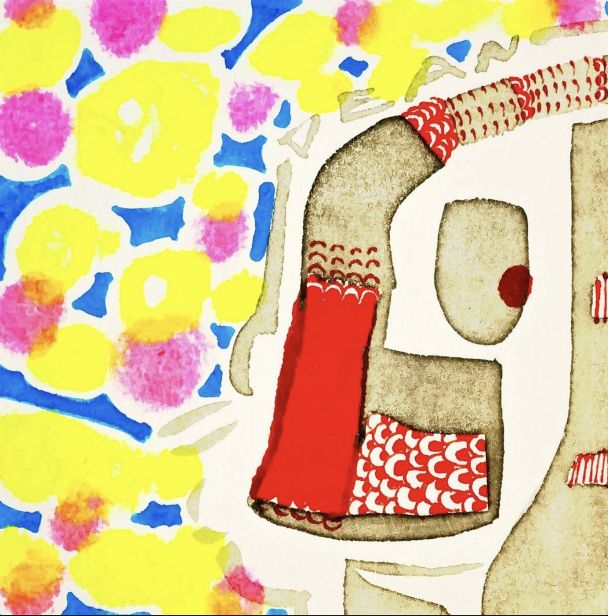
Because I couldn't move much physically, I was forced to slow down. Once I started drawing, though, I almost couldn't stop. Now I draw nearly every day. To me, the process feels a little like Nüwa creating life: rather than searching for a particular symbol or style, I keep overturning what I already know and creating images that didn't exist before.
Of course, my past experiences haven't actually disappeared. Everything you've seen, heard, and felt eventually finds its way back into the image in another form.
Q. You often say, “Start drawing” and “Done is better than perfect.” Without a sketch or predetermined theme, how does a work develop from its first mark to completion?
A. My process really does begin quite randomly. I don't start by deciding on a concept or theme, and I don't tell myself what I have to draw that day. Whatever paper, pen, or material happens to be around, I simply start.
The first few marks might be completely disorderly. But as the pen continues to meet the paper, the image begins to give me feedback. Gradually, I develop a sense of something and begin to recognize a possible figure or direction. At that point, it is no longer purely random. I start responding to what the image is giving me and adjusting accordingly.
Sometimes I think I'm drawing Zhong Kui, but as I continue, it might begin to feel more like Sun Wukong. The figure isn't determined from the beginning; it is discovered little by little through the process. Self-Generated Image developed in the same way. There was no predetermined theme, but eventually the image seemed to grow into a figure that hadn't existed before.
As for knowing when a work is finished, I ultimately rely on my aesthetic judgment and my sense of the overall balance of the image. When I feel that the work holds together, then it's finished.
Even if you think a drawing looks “bad” halfway through, don't give up on it immediately. Sometimes the work you dislike the most can surprise you if you keep going for a little longer.
Q. You emphasize forgetting technique and letting go of control, yet you also have more than twenty years of experience in spatial design. Can past experience really be forgotten, or does it return unconsciously in another form?
A. It hasn't been forgotten at all. What you draw is still connected to your past. You're simply no longer drawing by copying a particular object; instead, you're drawing from things you've experienced and felt before.
In the past, if I drew a hand, I would first think about proportion, structure, and spatial relationships. Now I draw first and think about it afterward. But all those years of training, experience, and aesthetic judgment are still there. They don't appear through the same rules anymore; instead, they return naturally through the image.
Q. From Color Tai Chi to your Zhong Kui series, traditional cultural symbols such as Tai Chi and Zhong Kui repeatedly appear in your work. How did they first enter your practice, and how do you use color and form to bring these traditional symbols into a contemporary visual context?
A. Color Tai Chi originally came from work related to Wudang Mountain and the theme of Tai Chi. Traditionally, Tai Chi is represented through black and white, yin and yang. But I felt that if it were to enter the lives of younger people today, especially within contemporary cultural and creative contexts, there could be new possibilities.
When I was younger, I also loved black and white. I thought it looked cool. At this stage of my life, though, I've become increasingly drawn to color, especially bright colors and even fluorescent tones. So I reinterpret Tai Chi according to my own understanding and imagination.
The same is true of Zhong Kui. After creating the first one, I continued making variations, almost like an “eldest brother, second brother, third brother” sequence. At the beginning, I hadn't necessarily decided that I was going to draw Zhong Kui. I gradually discovered the figure through the forms of the eyes, beard, eyebrows, and other features.
If you keep developing a single symbol, it is actually quite easy to form a recognizable style or series. But right now, I don't want to confine myself to one particular symbol, nor do I want to keep repeating something simply because it makes it easier for a gallery to recognize a complete series. For me, traditional symbols can be a starting point, but what matters more is using them to create something fresher, more playful, and more unknown.
Q. You have mentioned that the beginning of artistic creation can be highly random, while a work's meaning is often assigned later by both the artist and the audience. For you, does meaning gradually emerge during the creative process, or is it generated through viewing after the work is complete?
A. The beginning can be disorderly, but once you reach the middle of the process, the image starts leading you toward new ideas. The brushstrokes, paper, and materials continually give you feedback, and your thoughts change in response. By that point, concepts have already begun to form in your mind.
So the meaning of a work doesn't necessarily come from an initial plan. It might gradually emerge during the process of creation, or it might continue to be created afterward through the interpretations of both the artist and the audience.
I think everything in the world is a little like Tai Chi. We are always searching for some kind of balance within an image. Life works the same way: on one side, you love painting; on the other, you still have to support your family and work. The balance we look for in art and the balance we look for in life may, fundamentally, be the same kind of relationship.
Q. From your personal practice to the “Intuition Lab,” where do you hope to take this path? And what advice would you give to young people who are still searching for what they love, or who worry that it is too late to begin again?
A. Many of the things I'm doing now—painting, participating in markets, developing creative products, and building IP—aren't simply about proving that these things can make money. I want to explore this path myself first and then tell others: this is a path you can actually take.
I believe everyone can be an artist. Painting doesn't have much to do with what materials or tools you have. If you want to draw, you can simply pick up a pen and begin. It can be an outlet for emotion, but it can also become a real work of art.
AI can also be a very useful tool for creators. We can take the images we draw and develop them further into creative products or IP. The original idea comes from us, while AI helps generate more variations and possibilities for bringing it into the real world. For a child, seeing their own drawing quickly transformed into a real product—and perhaps even recognized by others—can create an incredibly valuable sense of confidence.
For myself, I still want to “walk on two legs.” When I need to work on furniture and spatial design, I'll continue doing that, while also maintaining my painting practice. Then I can select certain images from my works and develop them further through IP, licensing, and derivative products.
For young people, what I most want to say is: don't completely give up what you genuinely love simply because you have to work or make a living. Do the work you need to do, but even while watching television, resting, or during small fragments of free time, leave some space for creating.
I was already in my forties when I came back to painting. Sometimes it does feel a little late, and I regret the time I missed before. But at least I started again. In a way, these past two years of creating feel as though they have made up for a much longer period of lost time.
Don't let yourself become constrained by sketching, color theory, or systematic training before you've even begun. And don't be afraid to draw simply because you weren't professionally trained. Start drawing and let yourself go. In the end, what truly needs to be cultivated over time is your aesthetic sensibility—and everything you have seen, experienced, and felt.
---